

Building Smarter: Why Market Research Should Shape Design
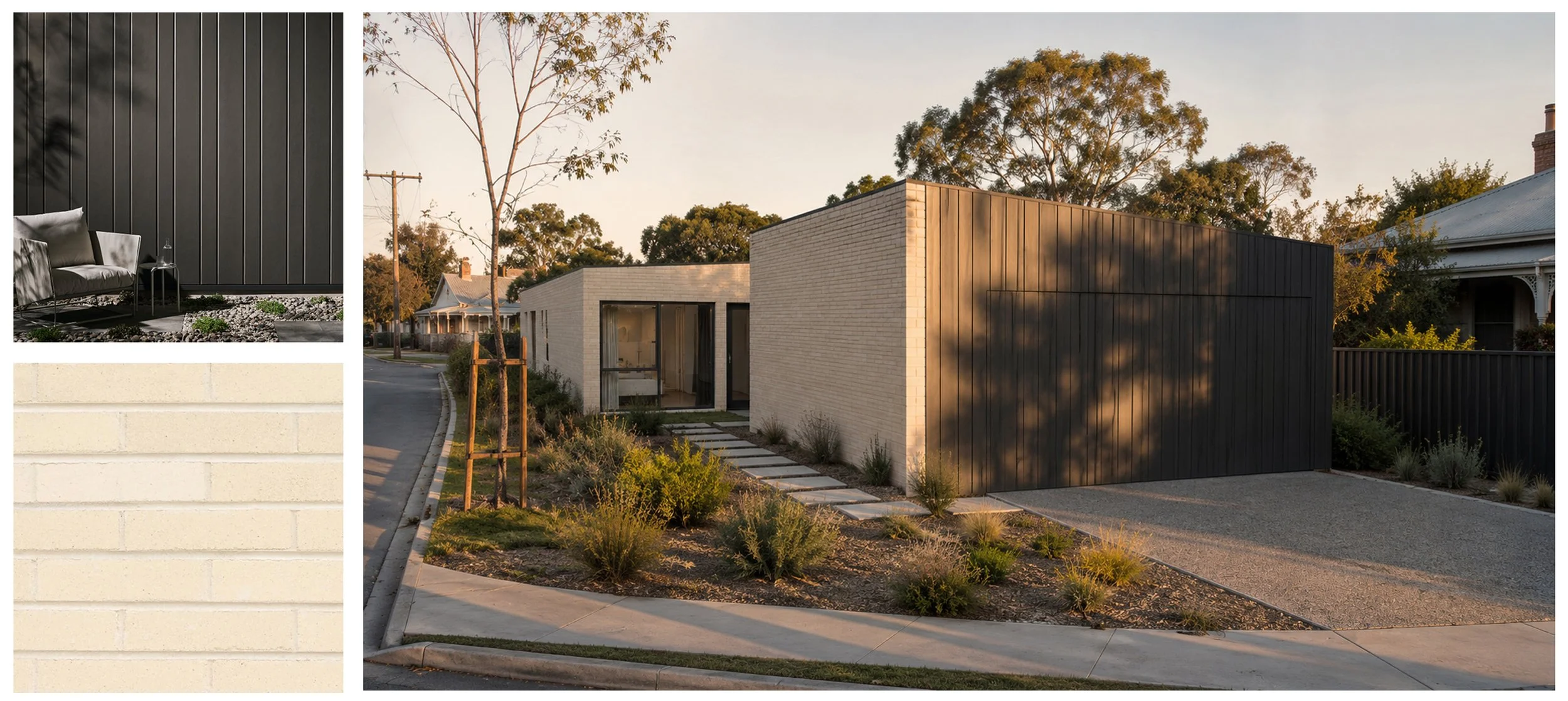
Artist impression of a contemporary Gippsland home exterior with curated material mood board featuring brick, timber, terrazzo and architectural finishes
When people think about residential design, the conversation usually starts with finishes, colours and inspiration images. Terracotta or white? Dark and moody or light and coastal? But long before any of those decisions are made, there is usually a less glamorous question sitting quietly in the background…Who is this actually for?
We're currently working on a project in regional Gippsland involving two new standalone homes on subdivided land. Three bedrooms, two bathrooms and double garages. On paper, fairly straightforward. But as with many projects, the challenge wasn't creating something beautiful. The challenge was creating something beautiful for the right buyer.
Because in residential development, design isn't simply a case of fabulous, artistic self-expression, it's a cold stone commercial decision.
The Design Balancing Act
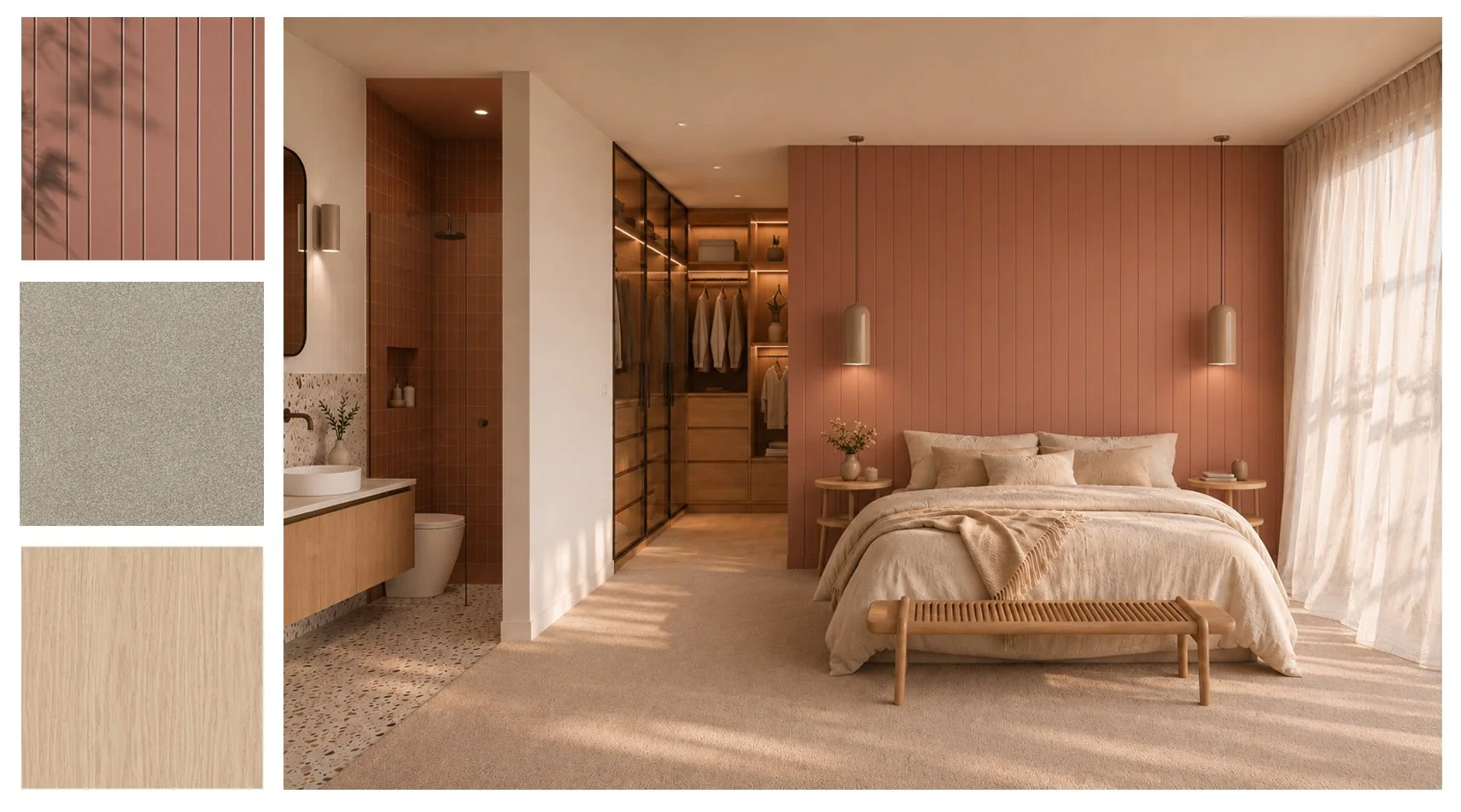
Artist impression of a contemporary master bedroom design in Bairnsdale featuring a terracotta panelled bedhead wall, warm timber finishes, soft natural bedding and an integrated ensuite and walk-in robe
For builders and mum-and-dad developers, there can be a natural nervousness around pushing too far creatively. Fair enough. Margins are tighter than they used to be, construction costs continue to shift and no one wants to create something that limits resale appeal. The conversation then too often becomes “Let’s play it safe”…..And safe usually starts drifting toward the same place. White kitchen. White walls. White bathrooms. Safe flooring. Safe fittings. Bland upon forgettable, and quite often, disposable bland.
The irony is that safe can sometimes become its own risk. Because if every competing property is delivering a similar product, the question becomes why would someone choose yours?
This is particularly the case when you're competing against larger homes, older homes on bigger blocks or volume builders offering more square metres for similar or less money.
For this project, the client initially had understandable concerns around moving too far outside the lines stylistically. The challenge became finding a middle ground between broad market appeal and creating something memorable enough to separate itself from a growing sea of lighter, cheaper and more generic alternatives.
That didn't mean suddenly specifying imported stone slabs everywhere or throwing budget discipline out the window. In fact, quite the opposite.
Good design innovation rarely starts with a bigger budget. It usually starts with a better idea. For this project, that meant introducing relatively simple moments with a disproportionate impact:
• Continuing exterior brickwork internally to create a fireplace feature and hearth
• Terracotta tiled shower spaces with painted ceilings
• Integrated lighting hidden within joinery
• Material continuity between interior and exterior
• Layering texture and contrast rather than layering cost
None of these decisions individually represent massive budget items. Collectively though, they change how a home feels.
Because buyers rarely say “The concealed power point strategy sold me." They say “I don't know why... I just loved it."
And usually the latter reaction is the result of dozens of smaller design decisions quietly working together in the background.
The interesting thing is this conversation is arriving at a time when the wider development landscape may also be changing.
The Rules Are Shifting
Recent Federal Budget announcements introduced significant proposed changes to negative gearing and capital gains tax arrangements, including limiting negative gearing concessions to new builds while aiming to encourage additional housing supply and owner-occupier opportunities. Supporters argue it may help improve affordability, while others have raised concerns around impacts on supply and investor confidence.
Regardless of where people sit on the policy debate, and no I’m not refereing to onions on the top or the bottom of the democracy sausage debate. I’m refering to a bigger question sitting underneath it:
If investors, developers and builders are increasingly pushed toward new housing stock, what becomes the point of difference?
Because if more people are building, and buyers become more selective, simply delivering another generic product becomes harder work. And perhaps that's where design becomes even more important. Not flashy, trend and brand driven design. B ut considered, researched strategic design. Design that understands who the likely buyer is and creates enough personality to stop them scrolling, while remaining disciplined enough that the project still stacks up financially….Because no amount of beautiful design can save a project if the feasibility disappears. The numbers still have to work.
But equally, watering a project down until it disappears into the crowd may not be the safest option either. Perhaps the real challenge is finding that middle ground. Enough distinction to be memorable. Enough restraint to appeal broadly. Enough creativity to elevate the outcome without elevating the budget.
Because sometimes the most valuable thing on a project isn't another finish upgrade.
Sometimes it's simply imagination.
References & Industry Insights
• Australian Bureau of Statistics (ABS) Census 2021 data, Bairnsdale and East Gippsland demographic profiles
Australian Bureau of Statistics
• Australian Government Federal Budget announcements and housing policy updates, including proposed taxation and housing reforms
Australian Federal Budget
• National housing and policy commentary relating to tax reform, affordability and housing supply impacts
ABC News Australia
• Property market insights and housing trend analysis
CommBank Property Insights
• Bairnsdale property market trends, pricing and housing data
realestate.com.au
• Regional housing and migration trends
Regional Australia Institute
• Local market observations and design strategy developed through DMP Creative project research and ongoing industry experience